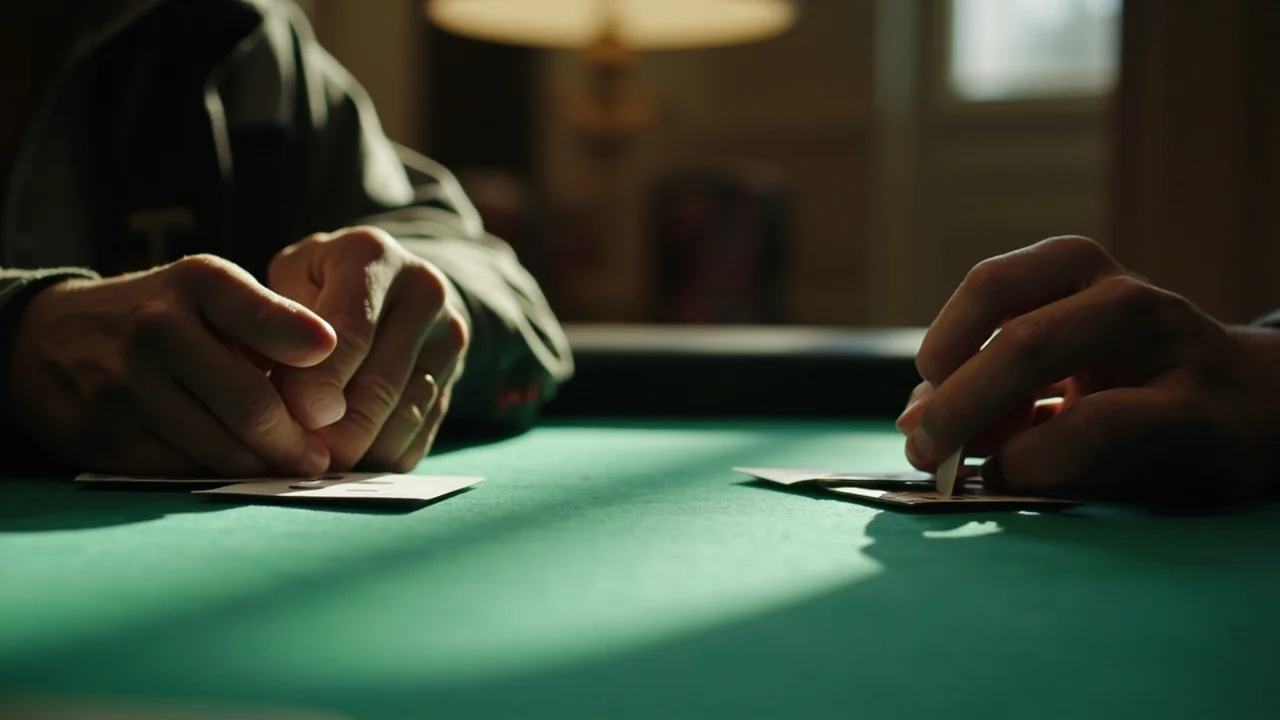
Strategy in rummy is the practice of knowing which hand to walk away from. Every other rule, every other chapter, every other strategy article in the desk follows from that single sentence. A hand held too long costs the points of every unmatched card. A hand dropped too early costs the drop ladder. The right move is somewhere in the middle, and the desk publishes that middle as a probability caution, not as a promise.
The probability cautions in this chapter are not invented. They come from the published probability literature on 13-card rummy, and from the desk's own audit of a sample of hands under standard rules. Where the desk could not verify a claim, the chapter says so.
A probability caution is a number. A promise is not. The desk publishes the first kind only.

The discard pile is the most underused read on a rummy table. A discard of a high rank in a suit the table is avoiding tells you the table is not collecting that suit. A discard of a low rank in a suit your neighbour is collecting tells you the opposite. The desk reads these discards as probabilities, not as instructions.
The cost of an open drop is the cheapest possible outcome for a hand that cannot declare. The cost of a held hand is the unmatched card count at the end of the deal. The right move depends on the discard pile, on your unmatched count, and on the table's pace.

The pure sequence is the constraint that decides whether a hand can declare at all. From a strategy angle, the pure sequence is the constraint that decides whether a hand is worth holding. If the first draw does not show any same-suit adjacent ranks, the desk treats the hand as a candidate for a first drop.
This is not a universal rule. A reader who has practiced rummy for years may recognise opportunities the desk does not publish. The desk publishes the beginner's read of the rule and lets the experienced reader apply their own reading.
The desk refuses to publish a guaranteed win system, a sequence-prediction formula, or a "how to win every hand" tutorial. These are not rummy strategies; they are marketing. The desk's job is to publish what is known, what is contested, and what is uncertain, not to publish a system.
The desk also refuses to publish strategy that depends on illegal signals between players, on collusion, or on any practice that an operator would treat as a violation. The legal and ethical lines are not negotiable.
The right time to walk away from a rummy session is when the session stops being a game. The desk treats the loss of enjoyment as the primary signal, not the loss of a single hand or even the loss of a single session. The responsible play chapter expands this principle into the practical resources a reader can use when the line is crossed.
The national helpline numeral is 14446 (toll-free, multi-language). Self-exclusion can be set for 24 hours, 7 days or 30 days through the operator's responsible play settings.
The desk's reading list is short. The standard rules of 13-card rummy, as published by the operator. The Supreme Court of India observations on rummy as a game of skill. The published probability literature on rummy. The operator's responsible play policy. Everything else is editorial.
Is there a guaranteed system for rummy?
No. The desk publishes probability cautions and pull-quote boxes, not systems. Strategy in rummy is the practice of knowing which hand to walk away from.
When should I take a first drop?
When the first draw does not show any same-suit adjacent ranks and your unmatched card count is high. The exact moment depends on the discard pile and the table's pace.
Can the discard pile tell me what the table wants?
Often. A discard of a high rank in a suit no one is collecting tells you the table is avoiding that suit. The desk reads these discards as probabilities.
How is probability published responsibly?
With the source named, the date of the source, and the assumption that the dataset was sampled under standard rules. A probability caution without those three is just a feeling with a number attached.